The real test of global payments is how local they get
How enterprise merchants can optimize their payment infrastructure platforms for global growth


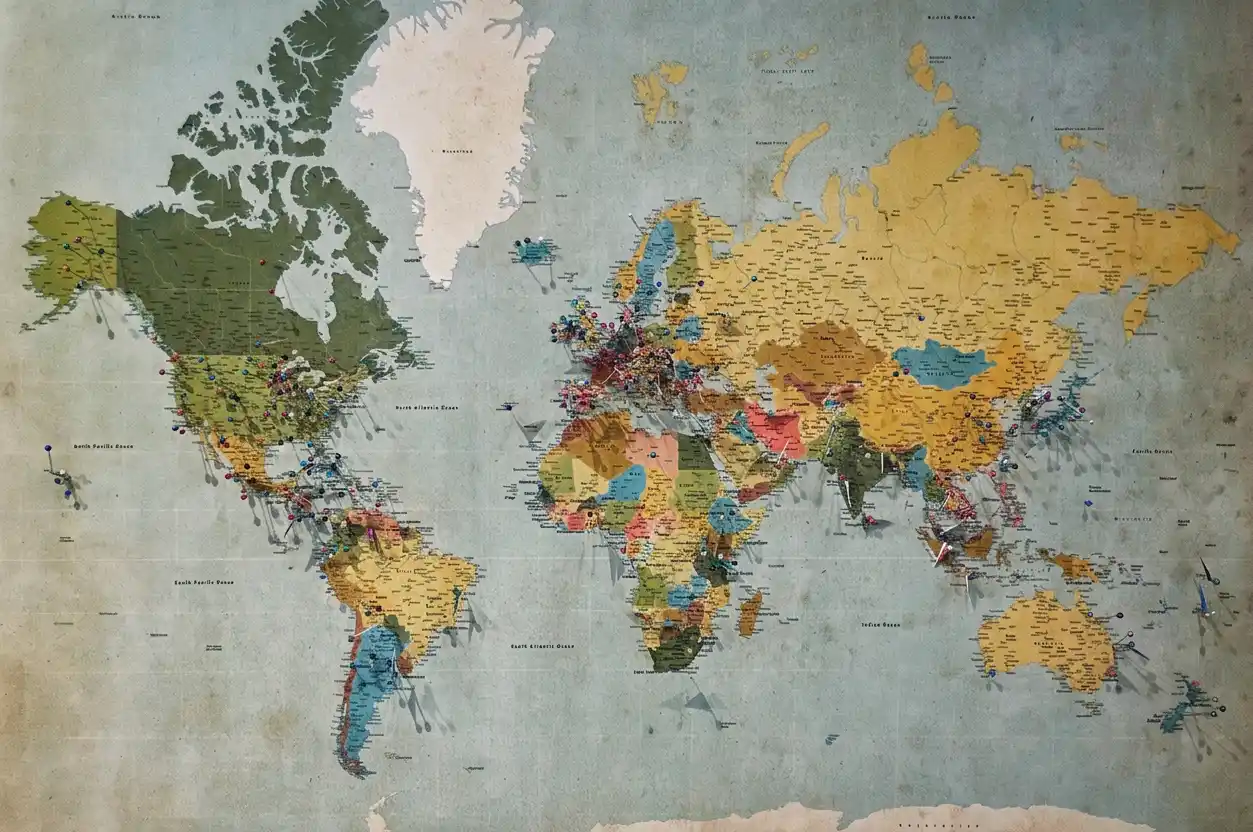
Every global payments provider will show you a map. The country count climbs, the flags fill in, the pitch tightens. Then volume starts moving and the story unravels.
Market count has become a vanity metric. What actually matters is what happens to approvals, settlement, and cost the moment real transactions flow. That's the line between routing a payment through an intermediary in another country and processing it in-country, with direct connections to local banks and schemes. One looks global, while the other actually is.
Commerce is global, but payments are stubbornly local. Every market has its own rails, its own regulators, its own definition of trust at checkout. No amount of AI sitting on top will fix an acquiring setup that was never built for the country it claims to serve, because intelligence only optimizes what the infrastructure allows. If a Mexican card transaction is routed through Miami, the best routing engine in the world can't make it land like a domestic payment.
That fragmentation has a direct revenue consequence. Local acquiring isn't a technical footnote, but one of the highest-leverage calls in a global payments strategy, and one of the most consistently misread.
It’s also a call that often gets misunderstood. An acquiring license is hard to get and expensive to maintain. So holding one is the clearest proof that a payment technology company has actually invested in a market rather than rented a route through it. A direct acquiring license earns the right to process cards without an intermediary. But the true merchant benefit and the experience their customers feel comes from what sits around the license itself: local payment method coverage, intelligent technology and operational presence. It’s important that all four show up together, because that’s the difference between processing in a market and truly performing in it.
What local acquiring actually is
Local acquiring means the acquirer and the issuer sit in the same country as the shopper. The scheme sees a domestic transaction while the issuer sees a familiar counterparty and almost every downstream variable changes as a result.
Approval rates climb because issuers approve domestic transactions at materially higher rates than cross-border ones. Cross-border interchange and scheme fees disappear. Settlement clears through local rails, so funds arrive in hours rather than days. Shoppers see their own currency at checkout, not a foreign transaction fee on their statement. Fraud decisioning sharpens because the signals are locally enriched.
These are the differences a finance team sees in a month-end close and a product team sees in a cohort report. At enterprise scale, the gap between local and routed processing in a core market is the difference between participating in that market and competing in it.
So when a provider claims 50, 100, 200 countries, the question isn't how big the number is. It's how many of those markets are served by genuine local acquiring, with direct scheme connections and regulatory presence, and how many are routed. The honest answer is usually a much smaller number than the headline.
Why Mexico makes the difference visible
Every enterprise business expanding internationally is making a portfolio decision. Which markets justify the investment? Where is the growth real and under-served? Mexico makes its own case and it exposes, faster than most markets, which payment platforms were built for global reach and which were built for local performance.
PCMI estimates Mexican ecommerce volume reached US$97 billion in 2024, making it the second-largest eCommerce market in Latin America. They project a 24% compound annual growth rate through 2027, taking the market to US$184 billion. That's a near-doubling in three years.
The composition of that growth is what makes Mexico interesting, and difficult for enterprise businesses. Cash remains the preferred daily payment method for 85% of the population, and roughly 24% the adult population is still unbanked. Card penetration is lower. The payment method mix is broader and more locally rooted than US or European playbooks assume: OXXO cash vouchers, SPEI bank transfers, DiMo real-time payments, Mercado Pago and other wallets, and the domestic Carnet card scheme alongside Visa and Mastercard. Miss any of these and a meaningful slice of the market is simply unreachable.
The regulatory picture is moving in the same direction. Mexico's acquiring landscape was bank-dominated for years. Reforms led by Banxico and the CNBV have opened it to licensed non-bank acquirers, and the 2018 Fintech Law created a formal framework for electronic payment institutions. In 2023 the Federal Economic Competition Commission formally flagged competition barriers in card processing and pushed for further reform. The market is opening and the providers best positioned to benefit are those investing in local infrastructure, not those routing harder. What works in simpler environments breaks down in Mexico.
What infrastructure commitment looks like
Genuine local acquiring is a set of concrete, verifiable commitments, and the answers to them separate real coverage from intermediate connectivity. The license is the entry ticket, but performance comes from what’s built around it.
Regulatory standing
A direct acquirer in Mexico holds a license from the CNBV and Banco de México. Without that authorization, a provider isn't a local acquirer; they're routing transactions through one.
Scheme infrastructure
A direct connection to PROSA, the domestic switch at the center of Mexican card processing, is what makes a transaction domestic from the issuer's perspective. Support for Carnet extends reach to cardholders unreachable through Visa and Mastercard alone. Settlement in pesos removes the FX layer from merchant cash flow. These are the mechanical levers that turn local acquiring from a claim into an outcome.
Payment method breadth
Cards alone don't address a market where vouchers, real-time transfers, and wallets account for so much of eCommerce volume. The strongest position is one integration covering the full local stack, so merchants aren't stitching together separate providers for OXXO, SPEI, DiMo, and cards, each with its own reporting and reconciliation.
Intelligent technology
Local rails get the transaction to the right place, while intelligent infrastructure decides what happens to it next. AI-driven routing chooses the path most likely to be approved; adaptive fraud models continuously learn from local signals and cloud-native architecture scales with volume rather than buckling under it. Without that intelligence, a local license is a faster way to process the same declines.
Presence
A local team that understands the regulators, speaks the language of merchants and shoppers, and is available in the same time zone when something breaks. Payments fail at 2am. When they do, the difference between a local team and a ticket queued in another hemisphere is measured in hours of downtime and thousands of declined transactions.
That's how market count becomes market performance. Nuvei's direct acquiring license in Mexico, our PROSA connection, our Carnet support, our peso settlement, our local team, our integrated coverage of the full Mexican payment stack through one API, are all real revenue drivers designed to ensure that businesses succeed in Mexico regardless of where they are headquartered. They are the building blocks of our infrastructure, designed to:
• deliver higher approvals on growing volume,
• lower processing costs on every transaction,
• enable faster settlement directly into peso accounts,
• power accurate fraud decisioning informed by local data.
One connection, every method that matters in the market: card acquiring through Visa, Mastercard and Carnet, alongside OXXO, SPEI, DiMo, Mercado Pago and the wallets shoppers actually use. The same setup applies across Latin America, so a regional merchant or a global business expanding into the region works with one provider, one integration, one standard of performance, market after market. They act as clear proof of our commitment to enabling growth for our customers through every payment, everywhere. And the benefit doesn’t stop with the merchant. Higher approvals, faster settlement and locally optimized transactions show up at the shopper’s checkout as something simpler: a payment that works the first time, in the method they trust, in the currency they expect. That’s how a payment technology company stops being a vendor in one country and becomes a gateway to the world: by bringing the same depth, the same intelligence, and the same standard of performance to every market a business operates in.
The measure that matters
Mexico is one of several markets where the difference between truly operating locally and through intermediaries is becoming impossible to ignore. Fast-growing, structurally complex, regulatorily active, unforgiving of routed connectivity. It's also where the payoff of getting it right shows up quickly in approvals, cost and cash flow, in share of a market that's close to doubling.
The global payments industry has spent a decade competing on breadth. The next decade will be won on depth. The businesses that capture the growth ahead will be the ones who chose partners with genuine local infrastructure in the markets that matter to them, not the ones who accepted the widest map.
The right partner isn't the one with the most flags on the map. It's the one that brings the same standard of performance, depth of local connection and intelligent infrastructure to every market a business operates in. That's what makes a payment technology company work like one system instead of fifty, and it's what turns a merchant's expansion strategy into an experience their customers actually feel.
Commerce is global. Payments are local. Growth belongs to the businesses building on infrastructure that understands the difference.

.webp)